If you own a black car, you already know the feeling. You wash it carefully, dry it properly, and stand back feeling good about it. Then you drive it to work, park it outside for a few hours, and come back to find it looks like it hasn’t been washed in two weeks.
It’s not your imagination. Black cars genuinely are harder to maintain than lighter colors — not because they attract more dirt, but because they show every trace of it with almost no mercy.
I’ve been doing professional detailing for seven years. Black cars are the ones that come in most often looking rough, and also the ones that look the most dramatic after a proper correction. Here’s what’s actually going on with black paint — and what makes a real difference.
Why Black Paint Shows Everything
Black doesn’t pick up more dust, road grime, or water than white or silver does. The physics are the same. What’s different is the contrast.
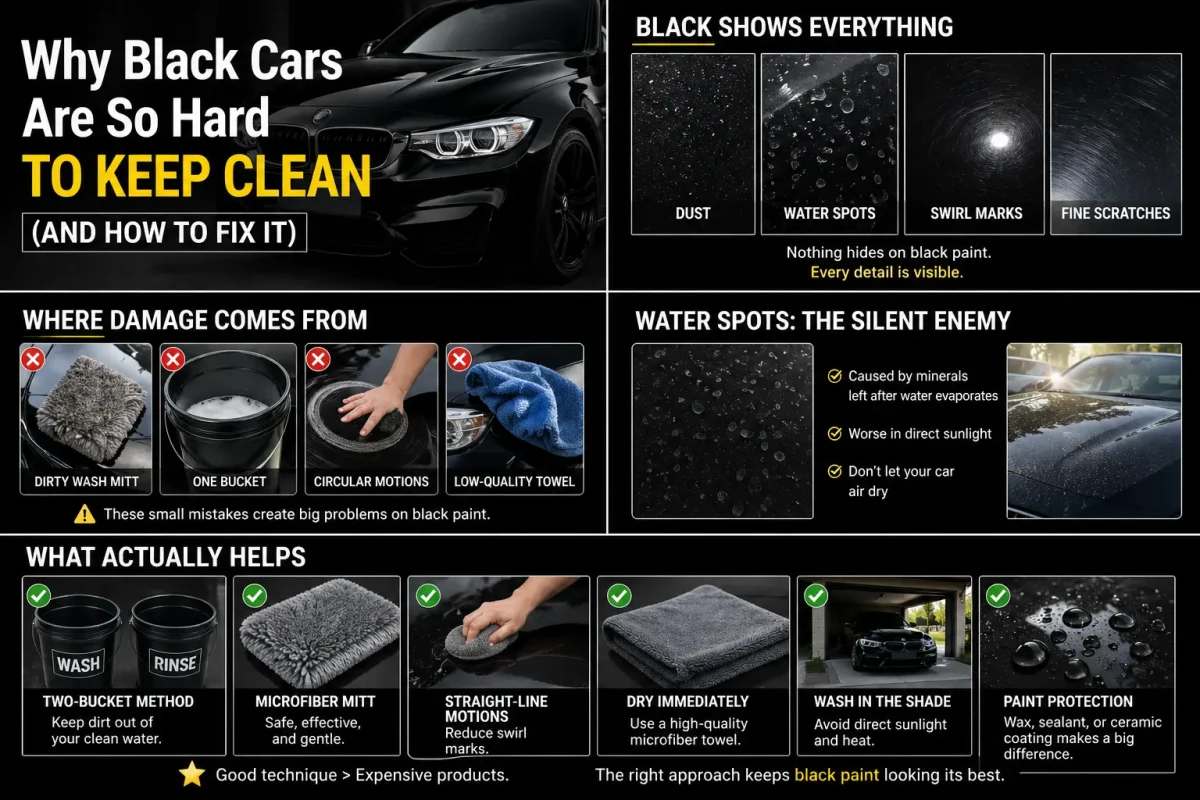
On a light-colored car, dust and minor surface imperfections blend in. On black, even a thin layer of dust from a single day of driving is clearly visible. Water spots stand out sharply against dark paint. Fine scratches and swirl marks that would be nearly invisible on a silver car become obvious in direct light on a black one.
This is the core issue. Black paint isn’t more fragile. It’s just less forgiving. Every imperfection gets highlighted rather than hidden.
Swirl marks in particular are the biggest problem with black cars. These are the fine, circular micro-scratches that build up from washing. On a light car, you might not notice them for years. On black paint, they create a hazy, web-like pattern across the surface that’s visible in virtually any direct light. Once you know to look for it, you can’t unsee it.
Where Most of the Damage Actually Comes From
This is the part that surprises most black car owners: the majority of the scratches and swirl marks on their paint didn’t come from accidents or road debris. They came from washing.
Using a dirty wash mitt — one that hasn’t been rinsed properly between passes — drags grit and debris across the surface. Using a single bucket means you’re dipping a contaminated mitt back into the same water and spreading that contamination around. Washing with circular motions creates circular scratches. Drying with a low-quality towel does the same.
None of these mistakes are obvious in the moment. You’re washing the car, the dirt is coming off, it looks clean when you’re done. The damage is happening at a microscopic level. On a black car, that damage accumulates visibly faster than on any other color, which is why so many black car owners end up feeling like their car is perpetually dirty or dull no matter what they do.
The problem usually isn’t the car. It’s the wash routine.
Water Spots: Why They’re Especially Bad on Black
Water spots are something every car owner deals with, but they’re particularly visible on dark paint.
When water evaporates from a surface — whether from air drying or washing in direct sunlight — it leaves behind the dissolved minerals it contained. These minerals sit on top of the clear coat and create small circular marks that are dull and slightly raised. On white or silver paint, they’re subtle. On black, they can look severe.
Two habits cause most water spot problems. The first is letting the car air dry after washing. The second is washing in direct sunlight, where heat causes water to evaporate before you can rinse or dry it properly. Both are easy to fix once you’re aware of them.
What Actually Helps: A Practical Approach
The good news is that none of this requires expensive products or hours of extra effort. It mostly comes down to adjusting a few habits.
Use the Right Tools From the Start
A microfiber wash mitt makes a significant difference on black paint. Unlike sponges, which hold dirt against the surface, microfiber lifts particles away from the paint. Combined with a two-bucket system — one bucket for clean soapy water, one for rinsing the mitt — you dramatically reduce the amount of contamination coming into contact with the surface during a wash.
Use straight-line motions rather than circular ones. It sounds like a small thing, but swirl marks on black paint are circular because most people wash in circles. Straight lines leave straight marks, which are far less visible.
Dry Immediately and Properly
After rinsing, dry the car right away with a clean, high-quality microfiber drying towel. Don’t let water sit on the surface and don’t let the car air dry. Pat or drag gently — don’t scrub. If you have access to a leaf blower or a dedicated car dryer, using one to blow water out of panel gaps and mirrors before hand drying is genuinely useful.
Avoid Washing in Direct Sunlight
This applies to all cars, but it matters more with black because the surface heats up faster. Wash in shade, in a garage, or during cooler parts of the day. Morning or evening works well. The goal is simply to prevent water and shampoo from drying on the surface before you can rinse them off.
Consider Paint Protection
This is where the biggest long-term difference comes from.
A good paint sealant or carnauba wax creates a sacrificial layer over the clear coat. Dirt and water bead off more easily, washing becomes less risky, and the paint underneath has a degree of protection it didn’t have before.
Ceramic coating goes further. A professionally applied ceramic coating bonds chemically to the clear coat and creates a harder, smoother surface that resists contamination and makes the car noticeably easier to clean. It’s an investment upfront, but for a black car owner who cares about how the paint looks, it changes the maintenance picture considerably. Water sheets off rather than sitting. Dust doesn’t bond as easily. Washing carries less risk.
I’ve seen the difference ceramic coating makes on black cars many times. It doesn’t make maintenance effortless, but it makes it manageable in a way that nothing else quite does.
The Honest Bottom Line
Black cars aren’t harder to clean. They’re harder to keep looking good with careless technique. That’s an important distinction.
If you’re doing everything wrong — one dirty bucket, circular scrubbing, air drying in the sun — a black car will show you exactly how wrong faster than any other color will. Fix those habits, and the same black paint that seemed impossible to maintain starts looking consistently better with less frustration.
The car hasn’t changed. The approach has.
If you have a black car and you’re dealing with swirl marks or water spots, feel free to drop a comment below. Happy to suggest next steps based on what you’re actually dealing with.
Why Black Cars Are So Hard to Keep Clean (And How to Fix It) – Inside Korea with ZEVI
[url=http://www.g6ij95e77xkt9ae0l28pek8790dn2i90s.org/]uvclyfdyoxz[/url]
avclyfdyoxz
vclyfdyoxz http://www.g6ij95e77xkt9ae0l28pek8790dn2i90s.org/