Most conversations about the cost of living in Korea start and end with Seoul. But Seoul isn’t the only option — and for a lot of people, it’s not even the best one.
I live in Daejeon. It sits right in the geographic center of South Korea, about 45 minutes from Seoul by KTX bullet train. I’ve been here for years. The cost difference compared to the capital is something I think about in practical terms every single month.
Here’s a real breakdown of what daily life actually costs in Daejeon — with numbers.
How Much Cheaper Is Daejeon Than Seoul?
The short answer: significantly.
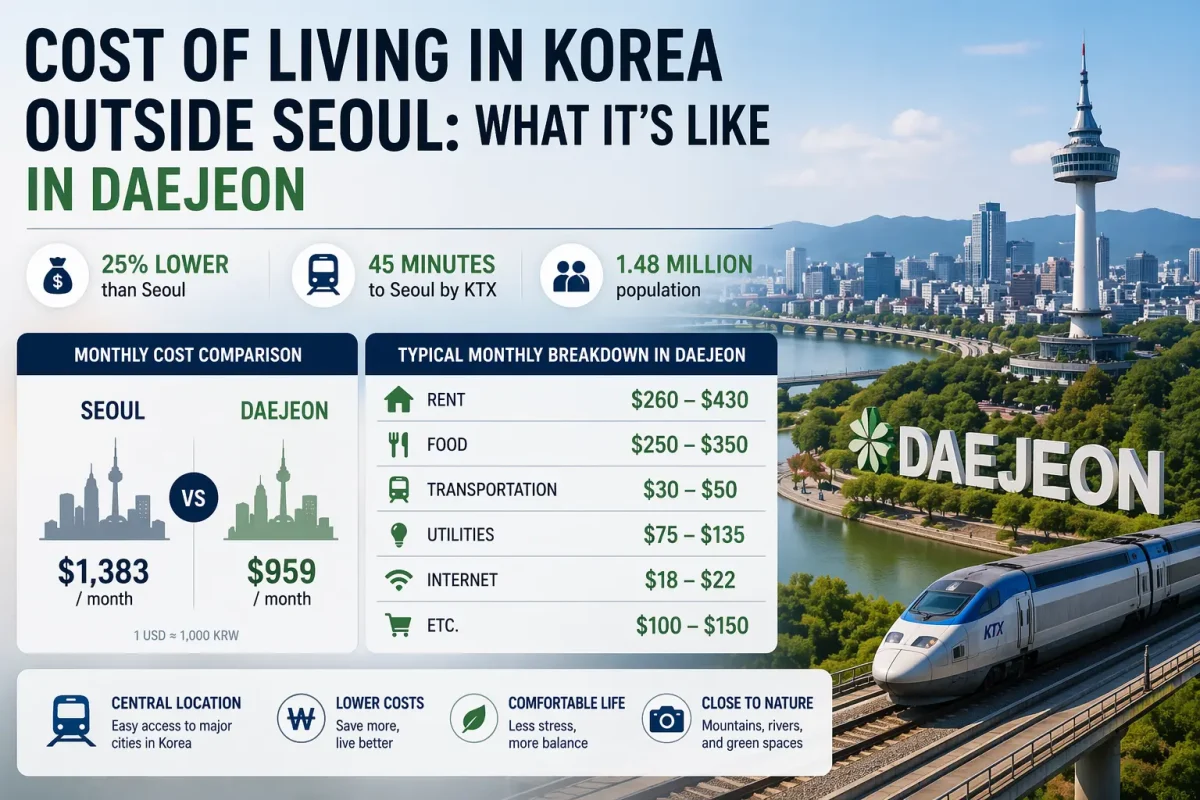
The cost of living in Daejeon is approximately 25% lower than in Seoul. To put that in concrete terms: the equivalent of a Seoul lifestyle costing ₩9,070,000 per month would cost around ₩6,830,000 in Daejeon.
That’s not a rounding error. That’s a meaningful difference in what your money actually does for you each month.
The average monthly cost of living in Daejeon comes in at around $959, making it one of the more affordable major cities in the country. Seoul, by comparison, runs closer to $1,383 per month when rent is included.
Rent: The Biggest Line Item
Rent is where the gap is most visible.
Rent prices in Daejeon are 53.7% lower than in Seoul — which is a striking number when you say it out loud. More than half. For the same money you’d spend on a modest studio in a central Seoul neighborhood, you can rent a significantly larger apartment in Daejeon.
In Daejeon, monthly rent for a typical apartment ranges from around ₩300,000 to ₩500,000 — roughly $260 to $430 USD, depending on the area and the age of the building. University districts and newer developments tend to run at the higher end; older neighborhoods offer genuinely low rents that are hard to find anywhere near Seoul.
It’s worth noting that Korea also uses a unique deposit system called jeonse, where a large lump-sum deposit is paid upfront in exchange for rent-free living. This can be a significant advantage for anyone coming with savings, since monthly cash outlay essentially drops to zero.
Food: Eating Well Without Spending Much
Food in Korea is one of the areas where the country punches well above its weight, regardless of where you live.
Restaurant prices in Daejeon run about 23.8% lower than in Seoul. A standard lunch at a local Korean restaurant — bibimbap, kimchi jjigae, a set meal — typically costs between ₩8,000 and ₩12,000 (around $6–$9). That’s a full meal with side dishes included.
Convenience store culture in Korea is something that genuinely surprises most foreigners. Chains like GS25, CU, and 7-Eleven sell freshly made food, triangle kimbap, hot items, and decent coffee at prices that make eating on the go cheap and easy. A filling convenience store meal can come in under ₩5,000 ($3.50).
Grocery shopping is where you’ll want to be a bit more strategic. Imported goods and some produce run higher than Western equivalents, but local staples — rice, eggs, tofu, vegetables, pork — are very reasonably priced. Cooking at home in Daejeon is one of the most effective ways to keep monthly costs low.
Transportation: Getting Around (And Getting Out)
Daejeon has its own metro system, and city buses cover most of the urban area. A single public transport journey costs around ₩1,200 — roughly $0.87. Monthly transport passes are available and make daily commuting very affordable.
The bigger transportation story, though, is what Daejeon’s central location means for getting out of the city.
Seoul is 45 minutes away by KTX. Busan is about 90 minutes. Gwangju, Daegu, and Jeonju are all reachable in under two hours. Trains run dozens of times daily, and tickets are booked easily through the Korail or SRT apps. Living in Daejeon doesn’t mean staying in Daejeon — it means having the rest of Korea at arm’s reach without paying Seoul prices to sleep there.
Utilities and Internet
Utilities in Korea are generally reasonable. A typical monthly bill for electricity, gas, and water in a standard apartment runs somewhere between ₩100,000 and ₩180,000 ($75–$135), depending on the season. Summer and winter push bills higher due to air conditioning and heating use.
Internet in Korea is among the fastest and most affordable in the world. Gigabit fiber connections are standard, and monthly plans typically cost around ₩25,000–₩30,000 ($18–$22). This is one of the areas where Korea — regardless of city — is hard to beat internationally.
Is Daejeon Right for You?
Daejeon isn’t Seoul, and it doesn’t pretend to be. The entertainment options are more limited, the international community is smaller, and the job market — particularly for English-speaking foreigners — is more concentrated in the capital.
But for people who want to live in Korea without paying Seoul prices, or who are drawn to a city with a strong science and research identity, a genuinely livable pace, and easy access to the rest of the country — Daejeon makes a compelling case.
With a population of around 1.48 million, Daejeon is South Korea’s sixth-largest city, with real infrastructure, good hospitals, universities, and everything needed for daily life. It’s not a compromise. It’s a different kind of city — one that works particularly well if you know what you’re looking for.
The 25% cost difference is real. The 45-minute train to Seoul is real. And the breathing room that comes with not paying capital-city rent? That’s real too.
Have questions about what life in Daejeon actually looks like day-to-day? Drop a comment below — happy to share more from the ground level.