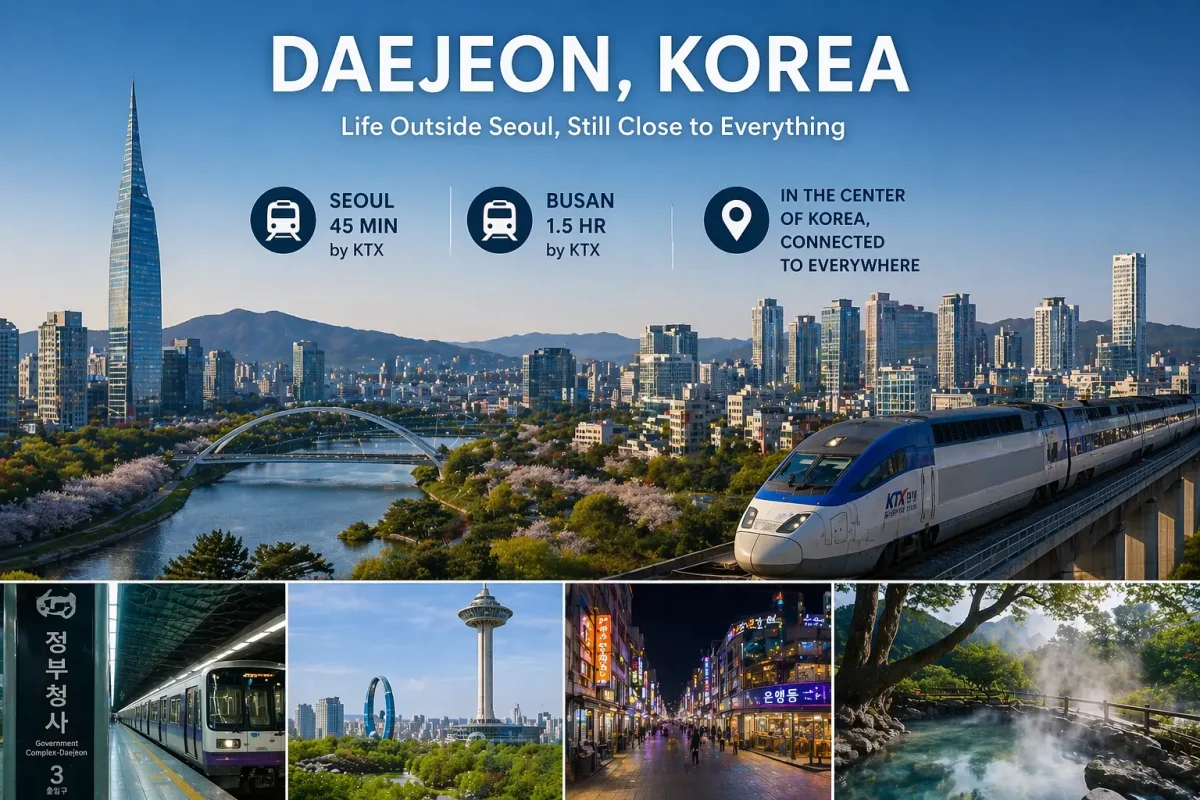
When people find out I live in Korea but not in Seoul, they usually assume something went wrong.
“Couldn’t get a job in Seoul?” “Is it boring?” “Why would you choose that?”
I get it. Seoul is the version of Korea that the rest of the world knows — the K-drama skylines, the Han River, the endless maze of trendy neighborhoods. If you’ve never been, Korea and Seoul feel like the same word.
But I’ve lived in Daejeon for years. It sits right in the geographic center of the Korean peninsula, and the longer I’m here, the more I think it might actually be one of the smartest places to be.
Here’s what living outside Seoul actually looks like.
Korea Is Smaller Than You Think
Before anything else, it helps to understand just how compact South Korea is.
The entire country is roughly the size of Indiana — or, for Australian readers, a bit smaller than Victoria. Within that space, an extensive high-speed rail network connects virtually every major city. The KTX bullet train can reach speeds of up to 300 km/h, which means distances that would take hours by car become something you barely notice.
From Daejeon, the numbers look like this. Seoul is about 45 minutes away by KTX. Busan — the second-largest city in Korea, on the southern coast — is around an hour and a half. Gwangju, Daegu, Jeonju: all reachable within an hour or two. The trains run dozens of times a day starting before 6am, and booking is easy through an app.
What this means in practice is that living outside Seoul doesn’t mean being cut off from Seoul. It means choosing not to pay Seoul prices to sleep there.
Daejeon: The City That Doesn’t Get Enough Credit
Daejeon isn’t small in any meaningful sense. It’s the fifth-largest city in Korea, with a population of around 1.5 million people. It has its own subway system, universities, shopping districts, restaurants, and everything else you’d expect from a major city.
What it’s particularly known for is science and technology. The Daedeok Innopolis — a massive research and science complex on the outskirts of the city — is home to hundreds of research institutes and tech companies, including major government science agencies. It’s given Daejeon a reputation as Korea’s science capital, and it attracts a well-educated, internationally minded population that gives the city a slightly different feel from purely commercial cities.
There’s also Expo Science Park, built for the 1993 World Exposition, and Yuseong — a district known for its hot spring spas that locals treat as a neighborhood amenity rather than a tourist attraction.
It’s not Seoul. It doesn’t try to be. But it has what you need, at a pace that’s noticeably easier to live at.
The Cost Difference Is Real
Here’s the part that tends to surprise people.
Rent in Seoul — particularly in the neighborhoods that foreigners tend to gravitate toward — is genuinely expensive by any international standard. A decent apartment in a central Seoul neighborhood can easily run ₩1.5–2 million per month or more. In Daejeon, a comparable apartment typically costs significantly less, often by 30–50%.
The same pattern applies to food, coffee, and everyday expenses. The convenience stores are the same (Korea’s convenience store culture is a gift regardless of where you are), but sit-down meals, local markets, and daily life generally cost less outside the capital.
For someone thinking about spending an extended period in Korea — whether for work, study, or just to experience living here — that difference adds up quickly.
But Seoul Still Has More, And That’s Just True
I want to be honest about this, because it’s real.
Seoul pulls people for a reason. It has more job opportunities, more international companies, more English-friendly environments, more of everything when it comes to career advancement or building a professional network. For foreigners coming to Korea specifically to work or to build something, the concentration of opportunity in Seoul is hard to argue against.
The entertainment, the food scene, the nightlife, the sheer variety of what’s available on any given evening — Seoul operates at a scale that no other Korean city matches.
So the honest answer is: if maximizing career opportunity or urban stimulation is the priority, Seoul makes sense. That’s why it keeps growing.
Why I’m Still Here
For me, the tradeoff works clearly in Daejeon’s favor.
I can be in Seoul for a lunch meeting and back by dinner. I can reach Busan for a weekend without it feeling like a big trip. My cost of living gives me room to run my own business without the pressure that comes with capital-city rent. And I live somewhere that’s calm enough to actually focus.
Korea outside Seoul is still very much Korea — the food, the culture, the infrastructure, the pace of daily life. It’s just Korea with a bit more breathing room.
If you’re thinking about spending time here and wondering whether it has to be Seoul — the short answer is no. It really doesn’t.
Curious about what daily life actually looks like in Daejeon, or thinking about visiting? Drop a question in the comments — happy to share more.