Driving in Korea can be convenient, but it can also feel a little overwhelming at first.
The roads are generally well maintained, navigation apps are useful, and traveling by car can make it much easier to visit places outside major city centers. But if you are a foreigner driving in Korea for the first time, there are a few things you should understand before getting behind the wheel.
1. Check Your License Before Driving in Korea
Before driving in Korea, the first thing to check is whether your license is valid here.
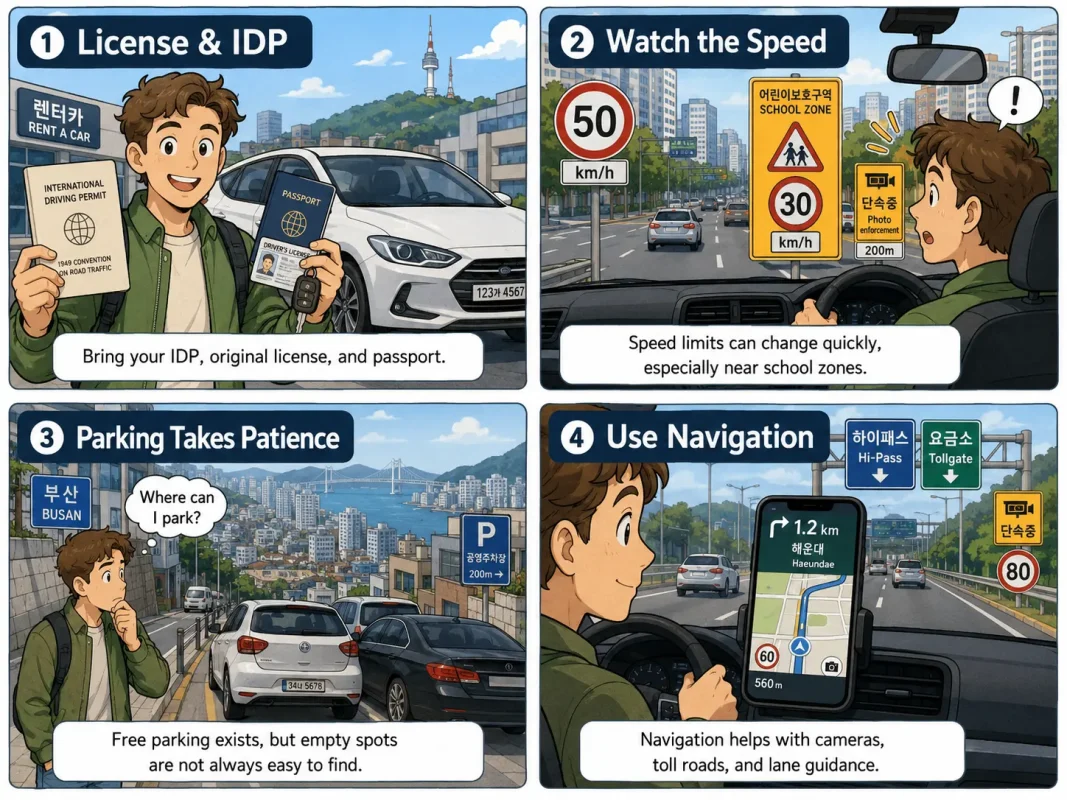
Short-term visitors can usually drive with a valid International Driving Permit, often called an IDP, along with their original driver’s license and passport. In Korea, an international driving permit is generally valid for up to one year from the date of entry, but the exact situation can depend on your license, country, and visa status.
If you plan to stay in Korea for a long time, it is better to check whether you need to exchange your foreign license for a Korean driver’s license.
2. Speed Limits Can Change Quickly
One thing that surprises many foreigners is how often speed limits change.
In many urban areas, drivers will see limits around 50 km/h on main city roads and 30 km/h on smaller residential roads or safety-focused streets. This 50/30 system has been used in Korean cities to improve pedestrian safety.
School zones are especially important. Many school zones are limited to 30 km/h, and drivers should be extra careful even when the road feels empty. Korea takes school-zone safety seriously, and the penalties can feel quite strict if you are not paying attention.
3. Navigation Apps Are Almost Essential
In Korea, many drivers use navigation apps even when they already know the road.
This is not only for directions. Navigation apps help drivers check speed limits, traffic cameras, road changes, toll gates, and traffic congestion.
For foreigners, this is especially useful because road signs, lane changes, and local driving patterns can be confusing at first. Even if the destination is only 10 minutes away, using navigation is usually a good idea.
4. Traffic Cameras Are Everywhere
Korea has many speed cameras, red-light cameras, and average-speed camera zones.
This does not mean driving is impossible or scary. It just means that you need to pay attention to the speed limit more carefully than you might in some other countries.
Sometimes the road feels wide enough to drive faster, but the speed limit may still be low. This happens often near schools, residential areas, and busy city roads.
5. Parking Is One of the Hardest Parts
For many people, parking is harder than driving in Korea.
In large cities like Seoul and Busan, parking spaces can be narrow, paid parking is common, and buildings often have their own parking rules. You can sometimes find free parking spaces, but that does not mean there are always many empty spots.
In Busan, this can feel even more noticeable because the city has hills, dense neighborhoods, busy tourist areas, and older streets in some districts. Driving itself may be fine, but finding a comfortable parking spot can take more time than expected.
6. Toll Roads Are Common
If you drive between cities in Korea, you will probably use toll roads.
Many expressways are paid roads, and drivers usually pay at toll gates or use Hi-Pass, Korea’s electronic toll collection system. If you rent a car, it is a good idea to ask whether the car has Hi-Pass and how the toll fees will be charged later.
This small detail can save some confusion when returning the rental car.
7. Korean Driving Culture Feels Fast
Korean driving culture can feel quick and sometimes a bit impatient.
Lane changes may happen suddenly, delivery motorcycles can appear between cars, and some drivers expect others to move quickly when the light changes. It is not always aggressive, but the rhythm can feel fast if you are not used to it.
The best approach is simple: do not rush, stay in the correct lane early, follow the navigation, and avoid making sudden decisions.
Final Thoughts
Driving in Korea is not necessarily difficult, but it is different.
Before driving in Korea, foreigners should understand the basics: license rules, speed limits, school zones, traffic cameras, toll roads, and parking. Once you get used to those things, driving can be one of the best ways to explore places beyond the subway map.
Especially outside Seoul, having a car can make daily life or travel much more flexible. Just remember that in Korea, driving is not only about knowing the road. It is also about understanding the local rhythm.