Parking in Korea can be more confusing than driving itself, especially if you are used to wider roads and larger parking spaces in countries like the United States or Australia.
The roads in Korea may feel busy at first, but navigation apps usually make driving manageable. Parking, however, is a different story. The rules and habits can change depending on where you are, whether it is an apartment complex, a shopping mall, a small restaurant, or a narrow neighborhood street.
If you are planning to drive in Korea, parking is something you should understand before you get behind the wheel.
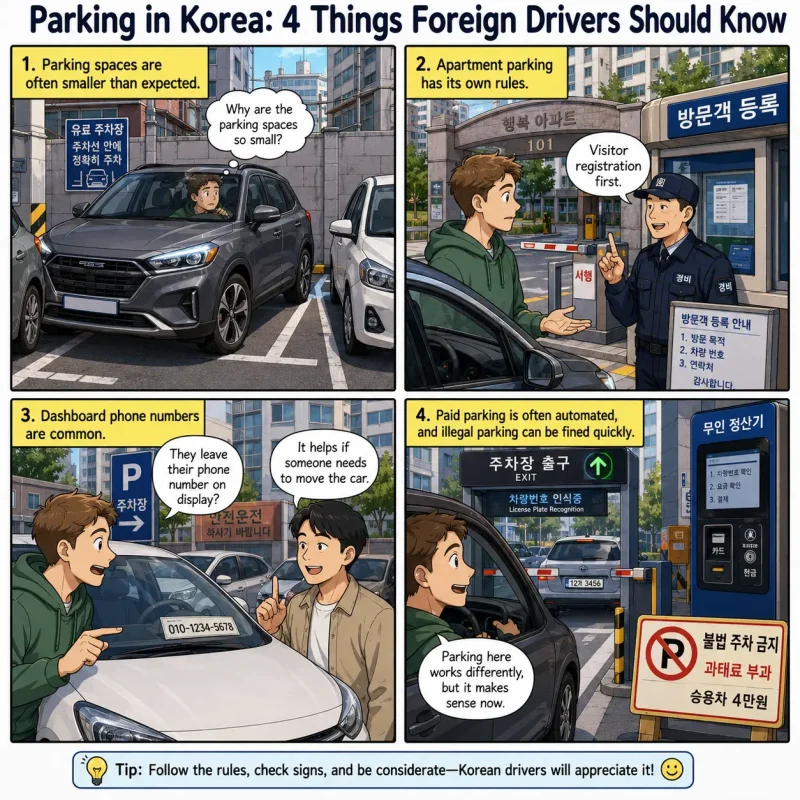
Parking Spaces Are Often Smaller Than Expected
One of the first things foreign drivers notice is the size of parking spaces.
In many parts of Korea, especially in older buildings or apartment complexes, parking spaces can feel narrow. If you are driving a large SUV or a wide imported car, parking may take more time than you expect.
This is not because Korean drivers enjoy difficult parking. It is mostly because space is limited, especially in cities. Many parking lots are designed to fit as many cars as possible into a small area.
For drivers coming from places where parking lots are wider and more open, this can be one of the biggest adjustments.
Apartment Parking Has Its Own Rules
Apartments are a major part of daily life in Korea, so apartment parking has its own culture.
Most apartment complexes require resident vehicles to be registered. Visitors usually need to register their car as well, either through a security office, an app, or a kiosk near the entrance.
If you forget to register your car, you may have to pay a parking fee when leaving. In some places, the gate may not open smoothly unless the vehicle has already been approved.
Double parking is also something you may see in older apartment complexes. When there are not enough spaces, some drivers park behind other cars and leave the gear in neutral so the car can be pushed if needed. This may feel strange to foreigners, but in Korea, it is a practical solution in places where parking space is limited.
Why Korean Drivers Leave Phone Numbers on the Dashboard
One thing that often surprises foreign drivers is that many Korean cars have a phone number displayed near the windshield.
This is common because parking spaces can be tight, and drivers sometimes need to contact each other quickly. If someone blocks another car, parks temporarily, or creates a problem in a narrow space, the phone number makes it easier to solve the issue without calling the police or towing the vehicle.
Of course, some people may feel uncomfortable displaying their personal number. These days, many drivers use temporary parking number plates or privacy-protection number services instead.
Still, if you drive in Korea regularly, having some way for others to contact you can be useful.
Paid Parking Is Often Automated
Many paid parking lots in Korea use license plate recognition systems.
You may not receive a paper ticket when entering. Instead, the system records your license plate automatically. Before leaving, you usually pay at a payment machine or at the exit gate.
In shopping malls, cafes, hospitals, and restaurants, parking may be free for a certain amount of time if you make a purchase. But there is an important detail. You often need to register your car number at the store or kiosk.
Having parking available does not always mean parking is automatically free.
A simple habit helps a lot. When paying at a restaurant or cafe, ask whether parking registration is available. Many Korean drivers do this naturally, but foreigners may not know they need to ask.
Restaurant and Cafe Parking Is Not Always Easy
Some restaurants and cafes in Korea say they offer parking, but that does not always mean parking is easy.
The lot may only fit a few cars. It may be shared with other businesses. In popular cafes or older neighborhoods, the parking space may fill up quickly, especially on weekends.
This is common outside Seoul as well, not just in big cities. A cafe may look spacious in photos, but the parking area can still be limited.
Before visiting, it is worth checking a map app to see whether there is a public parking lot nearby. Sometimes using a paid public parking lot is less stressful than trying to squeeze into a small private space.
Be Careful With Illegal Parking
Illegal parking in Korea can be reported quickly.
Areas near crosswalks, bus stops, fire hydrants, school zones, and intersections are especially risky. Even if you only stop for a short time, you may still receive a fine.
Korea also has citizen reporting systems, which means ordinary people can report illegally parked cars through an app. In busy areas, enforcement vehicles may also pass by regularly.
It is better not to assume that “just a few minutes” will be okay. If you are unsure, use a paid parking lot instead.
Final Thoughts
Parking in Korea is not impossible, but it can feel unfamiliar at first.
The spaces are often smaller, apartment parking has its own rules, phone numbers on dashboards are common, and many parking systems are automated. On top of that, illegal parking can be reported faster than some foreigners expect.
Once you understand these habits, parking becomes much less stressful.
If you plan to drive in Korea, learning the parking culture is just as important as learning the traffic rules. It will save you time, reduce stress, and help you avoid unnecessary fines.