Most people thinking about owning a car in Korea focus on the purchase price. That part makes sense — it’s the biggest number. But it’s not the number that surprises people.
What surprises people is everything that comes after.
I’ve been driving in Korea for years and running a car-related business for seven of them. The ongoing costs of car ownership here are genuinely higher than most people — especially those moving from other countries — expect going in. Here’s a realistic breakdown of what it actually costs.
The Purchase Isn’t the Hard Part
Korea has a solid domestic auto industry. Hyundai, Kia, and Genesis produce competitive vehicles at reasonable prices, and the used car market is active. Getting into a car isn’t dramatically expensive by international standards.
But when you buy a car in Korea, you immediately pay acquisition tax on top of the purchase price. The rate is generally 7% for standard vehicles. On a ₩30,000,000 car, that’s an immediate ₩2,100,000 added to the bill — before you’ve driven a single kilometer.
This is the first thing that catches people off guard.
Vehicle Tax: You Pay Even If You Don’t Drive
Korea’s vehicle tax (자동차세) is calculated based on engine displacement — specifically, the cc rating of your engine. It’s paid twice a year, in June and December.
The rates break down like this. Engines under 1,000cc pay ₩80 per cc. Between 1,000cc and 1,600cc, the rate is ₩140 per cc. Between 1,600cc and 2,000cc, it’s ₩200 per cc. Over 2,000cc, the rate is ₩220 per cc.
On top of the base tax, there’s an education tax surcharge of 30%.
For a mid-size sedan like the Sonata at around 1,998cc, the annual vehicle tax comes to approximately ₩520,000. For a larger SUV at 2,500cc, you’re looking at closer to ₩880,000 per year.
One thing worth knowing: if you pay the full year upfront in January, you get a 5% discount. It’s a small saving, but it adds up.
Electric vehicles have a fixed annual tax of ₩130,000 regardless of size — one of the clearer financial advantages of going electric in Korea.
Insurance: Required, and Not Cheap
Car insurance is mandatory in Korea. The cost varies significantly based on your age, driving history, the vehicle, and the level of coverage you choose.
As a rough benchmark, a 30-something driver with a clean record can expect to pay somewhere between ₩600,000 and ₩1,200,000 per year for comprehensive coverage on a standard sedan. Younger drivers, those with accident history, or owners of newer/higher-value vehicles will pay more.
Direct insurance (다이렉트 보험) — purchased online without going through an agent — is consistently cheaper than broker-arranged policies. Most experienced drivers in Korea use direct insurance as a baseline.
Fuel Costs More Than in the US
South Korea imports virtually all of its oil, and fuel prices reflect that.
As of early 2025, gasoline runs around ₩1,600 per liter. For comparison, that’s roughly equivalent to $4.30 per gallon in US terms — significantly higher than the US average, and closer to European price levels.
For a mid-size car driven 1,000km per month at around 12km/L fuel efficiency, monthly fuel costs come in at approximately ₩133,000–₩150,000. For an SUV at 10km/L, that rises to ₩160,000 or more.
Diesel is slightly cheaper at around ₩1,450 per liter, which is part of why diesel SUVs remain popular among Korean drivers doing higher annual mileage.
Maintenance and Parking Add Up Quietly
Routine maintenance — oil changes, tires, brake pads, battery — runs about ₩50,000–₩70,000 per month when averaged across the year for a standard sedan. Tires are a meaningful expense: a set of four for a mid-size car typically costs ₩400,000–₩1,000,000 depending on brand, replaced every 40,000–60,000km.
Parking costs vary by situation. Apartment residents often have included or heavily subsidized parking. City drivers without dedicated parking face fees that average around ₩650,000 per year nationally, though this varies widely by location. Underground lots in central Seoul cost significantly more.
What It Adds Up To
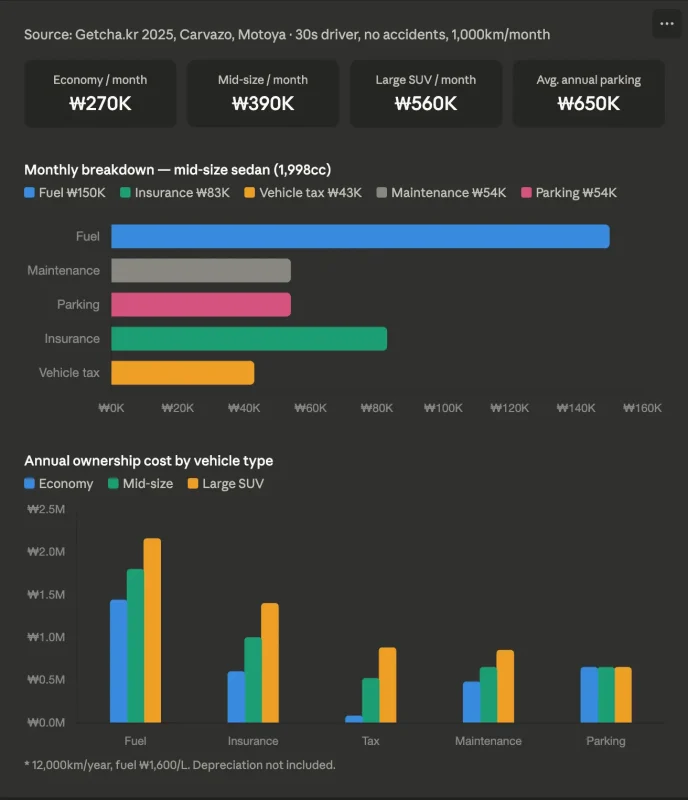
Pulling all of this together for a mid-size sedan driven 12,000km per year, the annual running costs break down roughly as follows.
Fuel costs approximately ₩1,800,000. Insurance runs around ₩1,000,000. Vehicle tax is about ₩520,000. Maintenance and consumables add another ₩650,000. Parking averages ₩650,000. The total comes to roughly ₩4,620,000 per year — around ₩385,000 per month — before depreciation.
For an economy car, that total drops to around ₩3,250,000 annually. For a large SUV, it rises to roughly ₩5,940,000 or more.
These aren’t worst-case numbers. They’re realistic averages for a careful driver in a mid-size city like Daejeon.
Why Koreans Still Own Cars
Despite the costs, car ownership rates in Korea have risen steadily. As of 2024, there are roughly 0.49 passenger cars per person — nearly one car for every two people.
Part of this is practical. Public transport is excellent in Seoul and major cities, but coverage thins out significantly in smaller cities and rural areas. For daily life outside the urban core, a car isn’t a luxury — it’s a necessity.
Part of it is also cultural. Cars carry social meaning in Korea in ways that are hard to fully appreciate from the outside. The brand, the model, and the condition of a vehicle communicate something about the owner — which is part of why the detailing business exists in the first place.
Owning a car here is a real ongoing commitment. Going in with a clear picture of the actual costs makes that commitment a lot easier to manage.
Have questions about car ownership costs in Korea, or thinking about buying here? Leave a comment below.
I feel that is among the most important info for me.
And i am glad reading your article. But wanna statement on few basic things, The site style is
ideal, the articles is really great : D. Excellent job, cheers
excellent post, very informative. I’m wondering why the opposite specialists
of this sector do not understand this. You must continue your writing.
I am sure, you have a huge readers’ base already!
No matter if some one searches for his essential thing, so
he/she wishes to be available that in detail, so that thing is maintained over here.